
The first Europeans to reach the kingdom of Bornu on Lake Chad were the British explorers Walter Oudney, Hugh Clapperton, and Dixon Denham. They left England in 1821, the same year Heinrich Barth was born in Hamburg, Germany. In one of history’s coincidences, Barth would be the next European to see Bornu, 30 years later.

At the palace of the Sheikh of Bornu, from a sketch by Dixon Denham
Barth’s father, Johann, was the son of German peasants who died when Johann was a boy. A relative in Hamburg took in the orphan. Though uneducated, Johann had the energy and ambition to work his way into the city’s middle class while building a thriving business as a trader in the cities along Germany’s northern coast. His success allowed him to marry well: Barth’s mother, Charlotte, came from a respected Hamburg family. The couple were strict Lutherans who raised their four children—Heinrich was the third—according to strict standards.

Richard Francis Burton
Some explorers, such as Richard Francis Burton and Samuel Baker, spent large parts of their boyhoods hunting, roaming the woods, and having open-air adventures that, in retrospect, were preludes to future exploits.
By contrast, the young Barth gave no sign that he would someday be a great explorer. Well, one sign: like Burton, Baker, and most other explorers, he was a misfit. Dweebish and physically weak, he devoted himself to art, languages, and book-collecting. His fellow students found him amusingly peculiar. He had few friends.
A childhood classmate later recalled that Barth “studied subjects that were not even part of the curriculum. People said that he was teaching himself Arabic, which to us brainless schoolboys certainly seemed the pinnacle of insanity.” Barth taught himself not only Arabic but English, which he could read and speak fluently by age thirteen, a handy skill in years to come. His other extracurricular missions included reading the histories, geographies, and scientific works of the classical Greeks and Romans, in the original languages.
In his mid-teens he undertook physical renovations. During recess, while the other boys played, he did gymnastics and arm exercises. To toughen himself he took cold baths, even in winter. By the time he entered the University of Berlin in 1839, he was a robust young man well over six feet tall.
There’s no evidence that Barth thought of these mental and physical regimens as preparations for life as an explorer. He was probably modeling himself after his beloved Greeks and their ideal of physical and intellectual excellence. He went to college expecting to earn an advanced degree and settle into a comfortable, sedentary career as a university professor.
Wanderlust and circumstances demolished those plans. During his second semester at the university, restlessness overcame him. He told his father he wanted to drop out and make an academic excursion to Italy, funded by Dad. Most parents, presented with this plan by a 19-year-old, would smell a boondoggle. Johann, however, knew his somber son had no interest in la dolce vita. He funded the trip.
Barth prepared with his usual diligence, first by learning Italian. He spent nearly a year traveling alone to classical sites throughout Italy, taking copious notes on everything he saw. “I am working terribly hard,” he wrote home from Rome in November 1840. “I go everywhere on foot. It has become no problem for me to walk around for nine hours without eating anything apart from a few chestnuts or some grapes.” The trip sparked a lifelong urge to see new places.
In June 1844 he received a Ph.D. for his dissertation on trade relations in ancient Corinth, a busy port like Hamburg. He moved back into the family home there and spent six months studying ten hours per day, in hopes of earning a university appointment. Nothing came of it.
Disappointed and itchy to escape his desk, he asked his father to fund another research trip, far more ambitious (and expensive) than the one to Italy. He wanted to circumambulate the Mediterranean Sea, visiting the three continents it touched and the cultures it influenced. Writing a scholarly book about his trip, he told Johann, would help him secure a university position. Johann again opened his wallet. The trip altered the course of Barth’s life.
 When Nasiru Datti was a boy in Kano, one of his jobs was to buy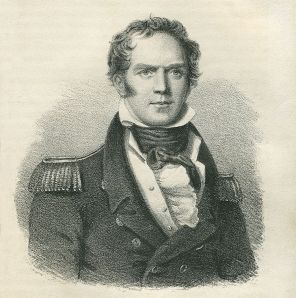


 Before we left Maiduguri he bought some on the street and passed them around. About the size of walnuts, they were dusty maroon in color. He and Nasiru Wada expertly cracked theirs open at the seam, revealing kernels that were a lovely deep pink. They offered me one. When I bit into it, my face involuntarily puckered at the bitter astringency. They burst into laughter, then resumed chewing. “These are excellent kolas,” said Nasiru Datti.
 When we arrived, Boko Haram had gone underground, but it still haunted the city, or at least my perceptions of it. (I later read that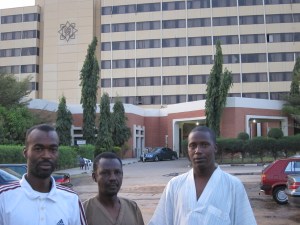
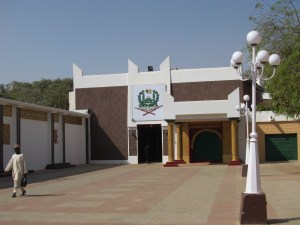
 By contrast, the red-brick palace of
  Next to the palace, a huge mosque was under construction. A long sandy piazza fronted both. At night, by tradition, the piazza became a play-space for children.
 One night, watching them play outside the palace, we met a district official dressed in a beautiful robe and cap. “Your sultan should come visit us in Kano,” said Nasiru Wada, “because he is our slave.”
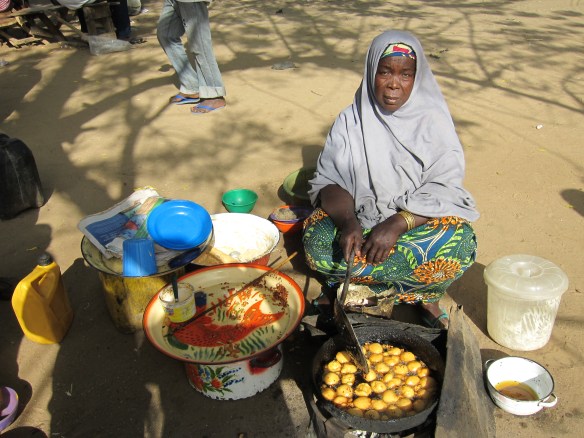 Several months after we left Maiduguri, Boko Haram emerged from underground. Energized and organized, they began
  The landscape after Gashua became flat scrub, offering long views in a palette of tans, browns, and dabs of dusty green. Nasiru Datti said it could be farmland but had fallen into disuse as the government ignored everything except oil. The land was also abandoned when Barth traveled through here. The cause then was slave raiders. Barth called the waste shameful, and blamed the greed and apathy of Bornu’s leaders. “Even the best of these mighty men,” he wrote, “cares more for the silver ornaments of his numerous wives than for the welfare of his people.”

 The men were quick and animated. They wore drab dirty clothing, though one of them sported the traditional conical Fulani hat. The women, in brightly patterned robes, carried themselves elegantly amidst the cows and mud. “They would make good wives,” said Nasiru Wada, partly joking. “They work hard, and they would walk to Gashua and never call a cab.”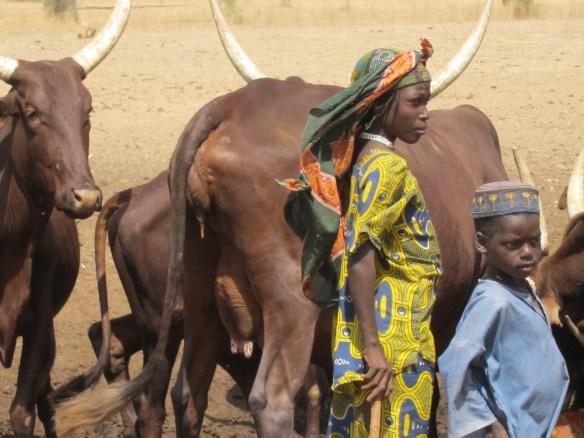


 The morning was beautiful–soft breezes, 70 degrees. “A bit cold,” complained Nasiru Datti. When we left Nguru nearly two hours later, the woman was still pounding millet. Her child still dozed on her back, lulled by a rhythm as strong, familiar, relentless, and fundamental as his mother’s heartbeat.


 The thought that rings through these like a chorus is “neglect.” No one tended Barth’s low flame more faithfully than A. H. M. Kirk-Greene. He became fascinated by Barth while serving as a British district officer in northeastern Nigeria (Adamawa and Bornu) before going on to an eminent academic career at Oxford. Between the late 1950s and early 1970s he wrote half a dozen enlightening essays about the explorer. He also persuaded Oxford to publish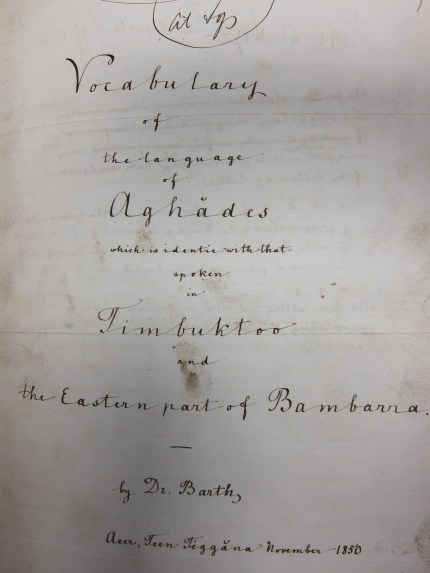


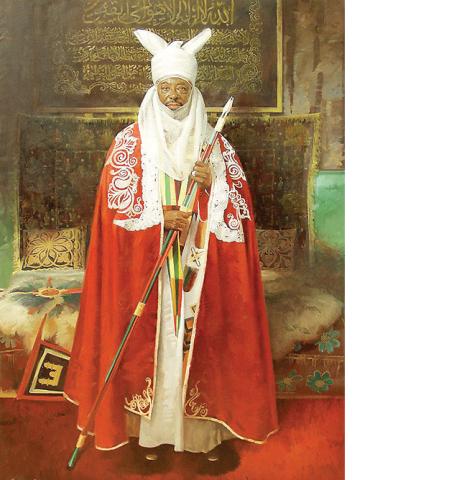


 One of my guides, Nasiru Wada, had grown up in the palace, because his father is the emir’s chief spiritual advisor. Now he and his young family had rooms at the rear of the palace, in the quarters of the royal slaves.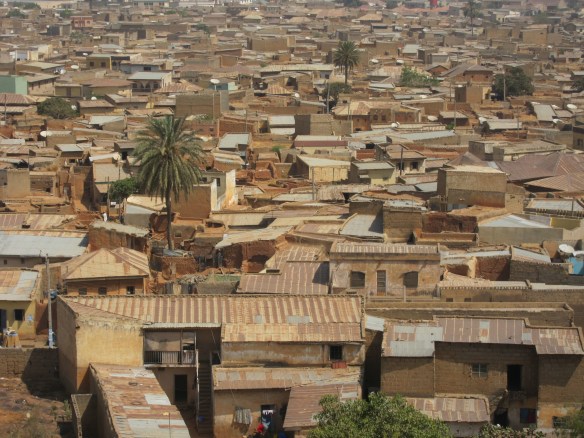
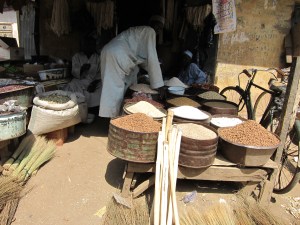
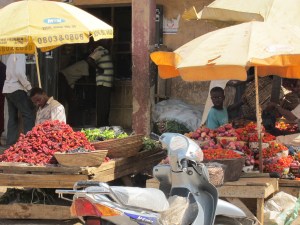 Both Clapperton and Barth were astonished by Kano’s market, the largest in central Africa. The
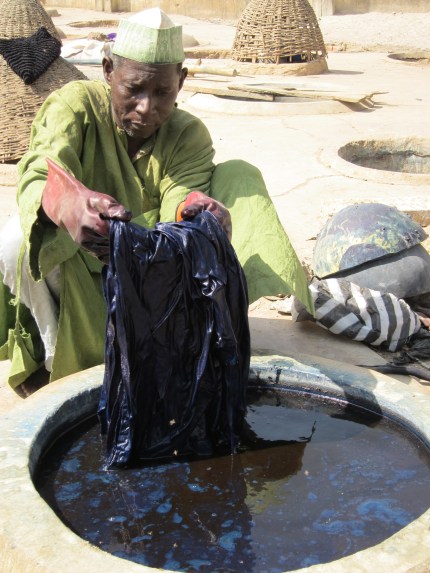 He mentions Kano’s dye-pits, in use since the end of the 15th century, and the tandem cloth-beaters. Both still operate. The dyers ferment dried indigo, potassium, and papaya ash in the 20-foot pits for four weeks. Then they dip cloth in and out: an hour-and-half for light blue, three hours for deep blue, six hours for blue-black. Patterns are made with the method called “tie-and-dye.”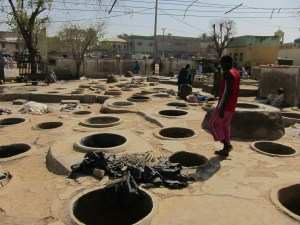
 In the Labyrinth