

Caravan routes
Many of today’s headlines about Islamic north-central Africa would look familiar to the explorer and scientist Heinrich Barth, who traveled 10,000 miles there for the British from 1850 to 1855. The caravan routes ridden by Barth are now roads, but the arid territories they cross are still a nexus of distinctive cultures that have mixed and chafed for centuries. Old frictions still flare up between Muslims and non-Muslims, black and brown, fundamentalists and moderates, central governments and local chiefs.
As in Barth’s day, bandits and fanatics keep the region in turmoil. The group Boko Haram (“Western education is forbidden”) has killed hundreds of people in places Barth visited in northeastern Nigeria, bombing government offices, schools, and Christian churches. The group’s violent quest to “purify” Islam is just the most recent of similar jihads reported by Barth. Other groups, now as then, use religion as a veneer to justify thuggery. The terrorists of al-Qaeda in the Islamic Maghreb (AQIM), for instance, seem motivated more by money than by Mohammed, kidnapping Western travelers whom they murder or ransom — behavior that Barth witnessed and survived.
For Barth, Boko Haram and AQIM would be familiar manifestations with historical precedents. So would the distress of today’s moderate Muslims who want to reclaim their religion’s traditions of tolerance and learning from gangsters and extremists.
Some current events are almost historical reenactments. In March of this year, after the Malian military staged a coup, several rebel groups took advantage of the political chaos to occupy Mali’s northern half, including the ancient desert towns of Timbuktu and Gao. The group that now controls Timbuktu is associated with AQIM and calls itself Ansar Dine (“Defenders of the Faith”). Like Boko Haram, the Ansar Dine are fundamentalists intent on imposing their version of a purer Islam. If history is a guide, they would have better luck pushing a camel through the eye of a needle.

Ibn Battuta
Since the time of Ibn Battuta (1352), visitors to Timbuktu have been impressed by the town’s scholars and amiable inhabitants, known for their love of singing, dancing, and smoking. The Ansar Dine have stopped the singing and the music, and are requiring women to veil their faces, atypical in Timbuktu. Tobacco and alcohol have been banned, places that sold them have been shuttered or destroyed, and possession of a cigarette brings a beating. Women have been whipped for immodest behavior such as walking alone or riding in a car with men. In a town near Timbuktu, an unmarried couple was stoned to death.
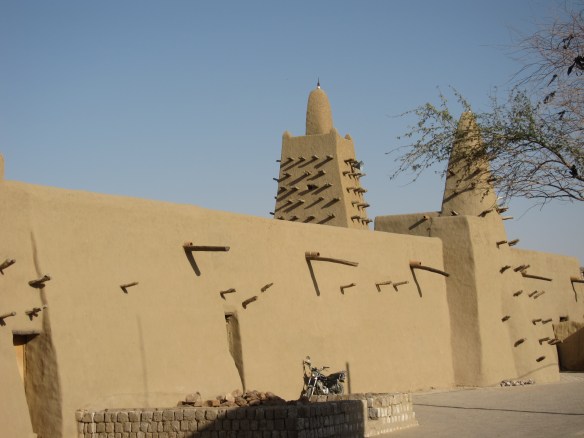 Ignorance, that frequent collaborator with fanaticism, has led the Ansar Dine to destroy at least half a dozen of Timbuktu’s historic tombs and monuments, including part of the fourteenth-century Djingereber mosque, on grounds of idolatry. Scholars fear that Timbuktu’s invaluable manuscript libraries might be looted, perhaps for the purpose of selling these volumes of old Islamic erudition to fund new Islamic intolerance.
 Timbuktu has weathered it all before. Similar restrictions were in place when Barth spent seven months there under house arrest in 1853-54. Muslim jihadists from the newly-declared kingdom of Hamdallahi (“Praise to God”) had conquered Timbuktu in 1826. They attempted to impose harsh reforms: no tobacco, mandatory attendance at mosque, segregation of men and women. The sociable smoking dancers of Timbuktu considered these dictates preposterous. By the time of Barth’s visit, the fundamentalists had despaired of separating Timbuktu’s men and women, but Barth recounts how they raided homes to seize tobacco and levied fines for insufficient piety.
Today’s residents of Timbuktu, Gao, and nearby desert towns have begun staging protests and forming militias to resist Ansar Dine’s severe version of Islam. It seems likely that long after Ansar Dine has vanished into history like Hamdallahi, Timbuktu and its people will still be singing and smoking.
Barth blamed much of the region’s misery on its greedy, corrupt leaders, who devastated the region with constant warfare and slave raids. “Even the best of these mighty men,” he wrote, “cares more for the silver ornaments of his numerous wives than for the welfare of his people.” Today’s Nigerians ask why their government can’t protect them from Boko Haram, and why a country with some of the world’s richest oil deposits must import most of its gas and can’t light its largest cities. Greed and corruption, wrote Barth, inspired violent purifying jihads that imposed their own repressions. These criticisms still sound fresh.
As in Barth’s day, most Westerners know little about Islam or Africa, and distort them into simple monoliths. Barth carried some of his era’s assumptions, but he was willing to go where the evidence took him. He found ignorance and savagery in Africa — the prevailing European view of the continent — but also scholars and sophisticated systems of commerce and government.
He likewise challenged the dominant European view of Islam as an evil dangerous opponent of Christian civilization, which still sounds familiar. Consider the recent Republican presidential primary, in which nearly every candidate expressed alarm about the nonexistent threat of Sharia law in the United States. Members of Congress are on record about “terrorist babies” and “stealth jihadis.” American towns have voted to ban mosques, and corporations tremble when fringe groups accuse them of being pro-Muslim.
Barth called Islam a great religion — not a popular view, then as now — but added that in some places it had been hijacked by brigands or fanatics who used it as an excuse to pillage or to subjugate. He pointed out that Islam wasn’t much different in these ways from Christianity, another great religion sometimes hijacked by the greedy or the self-righteous. All of this remains in the headlines.
Unlike most pundits about the continent, then as now, Barth formed his views from close observation of African reality. His news and perspective remain pertinent. As a scientist he believed that knowledge can dissolve ignorance and misunderstanding. Perhaps it still can, given the chance.
*This originally appeared on the History News Network on August 22, 2012.


 The keeper offered to show us the former boundaries of the old royal city. We drove about a mile into the empty countryside west of town. The keeper said all this had once been inside the walls. We stopped where a low broken wall surrounded a tall
  Barth mentions that Sheikh al-Kanemi supposedly built his new capital at Kukawa because of a young baobab there. The keeper told us a refinement of this local legend: the tree inside the broken wall had been a sapling when the adolescent al-Kanemi used to lean against it and dream of glory—that’s why he later sited his capital here. This pleasing story was flawed only by impossibility; al-Kanemi spent his boyhood far from Kukawa.
 I asked him if he had ever heard of Barth. Yes, he said, his father and grandfather knew stories about the explorer, but he himself knew little beyond the name. He had no idea where Barth’s house had stood in old Kukawa. And anyway, he added, Rabih had destroyed it.
 When we arrived, Boko Haram had gone underground, but it still haunted the city, or at least my perceptions of it. (I later read that
 By contrast, the red-brick palace of
  Next to the palace, a huge mosque was under construction. A long sandy piazza fronted both. At night, by tradition, the piazza became a play-space for children.
 One night, watching them play outside the palace, we met a district official dressed in a beautiful robe and cap. “Your sultan should come visit us in Kano,” said Nasiru Wada, “because he is our slave.”
 Several months after we left Maiduguri, Boko Haram emerged from underground. Energized and organized, they began
 In the Labyrinth